









Literacy, Language,
Learning and Thinking Skills
The NBSS takes a pro-active and practical role in addressing the variety of requirements associated with Adolescent Literacy, including the encouragement of critical thinking skills and metacognition that are essential in ensuring that young people are equipped with the skills they will need to pursue further education, obtain meaningful employment and engage in the benefits of lifelong learning. Hargreaves (2004) points out that ‘learning how to learn is a gateway to enhanced achievement and to the independence in learning that is a crucial developmental skill for students during the secondary years'.
'Simply, metacognition is thinking about thinking. When students are metacognitive, they have an understanding of learning in three areas: they understand themselves as learners, they understand a given task, and they understand a variety of strategies and how to use them in a variety of situations' (Jetton & Dole, 2004)
Research on metacognition, particularly in Literacy and Maths (Paris, Wasik &Turner, 1991; Schoenfeld, 1992; Marzano 2000), makes the case that instruction and support in the control and regulation of thinking processes can have a strong impact on achievement and Adolescent Literacy research (Kamil et al 2008) on reading ability points out that it is a key predictor of achievement in Maths and Science.
'Adolescents often need more sophisticated and specific kinds of literacy support for reading the content-areas, or academic disciplines.' (Lee & Spratley, 2010)
Literacy researchers are increasingly addressing the specific demands of academic disciplines within the post primary curriculum, as adolescents often need more sophisticated and specific kinds of literacy support for reading in subject areas, or academic disciplines. They argue that each subject area presupposes specific kinds of background knowledge about how to read texts in that area and often requires a particular type of reading (Gutherie et al., 2004; Schoenbach, et al., 1999; Shanahan & Shanahan, 2008; Yore, et al., 2003; Moje, et al., 2008; Lee & Spratley, 2010).
For example, the demands of comprehending scientific text include not only an understanding of cause and effect and sequencing but also additional skills based on scientific reasoning and the ability to evaluate scientific arguments. The driving idea behind disciplinary literacy is that knowledge and thinking must go hand in hand and for students to develop literacy in a particular discipline, they must grow in these two dimensions simultaneously. Therefore reading and learning in each subject area requires a variety of thinking tools that direct students to engage in discipline specific reading strategies.
As students advance through school they encounter increasing amounts of text, technical vocabulary, disciplinary discourses and demands for sophisticated text processing. These high level reading skills require knowledge of how disciplinary ideas are communicated and how texts in each discipline are constructed. NBSS Level 1 school-wide academic literacy support aims to provide schools with research-validated practices in reading, vocabulary, writing and oral communication skills, as well as thinking, learning and study skills development. Embedding practices to acquire these skills into all subject areas not only facilitates deep learning and understanding of subject content but also enables students to become effective learners, learning how to learn and developing those skills and competencies necessary to achieve and succeed at second level and beyond.
Disciplinary literacy 'involves the use of reading, reasoning, investigating, speaking, and writing required to learn and form complex content knowledge appropriate to a particular discipline.' (McConachie & Petrosky, 2010)
Each subject has specific literacy and language demands linked to:
- the types of texts that students need to be able to read and write
- the specialist vocabulary associated with that subject
- the specific language that students need in order to understand and explain the different knowledge, ideas, and perspectives of the subject.
Students develop subject area literacy skills and knowledge more successfully when they are explicitly supported with a range of strategies to learn with and apply across subject areas. By integrating effective research-based strategies into routine classroom practice, teachers can enable students to read and write a wide range of texts, help them to become strategic thinkers and problem solvers and provide them with opportunities to apply reading and learning strategies in many different contexts.
Discipline Specific Reading Strategies
- Build prior knowledge
- Build specialised vocabulary
- Learn to deconstruct complex sentences
- Use knowledge of text structures and genres to predict main and subordinate text
- Map graphic (and mathematical) representations against explanations in the text
- Pose discipline relevant questions
- Compare claims and propositions across texts
- Use norms for reasoning within the discipline (i.e. what counts as evidence) to evaluate claims
General Reading Strategies
- Monitor comprehension
- Pre-read
- Set goals
- Think about what one already knows
- Ask questions
- Make predictions
- Test predictions against the text
- Re-read
(from Reading in the Disciplines; The Challenge of Adolescent Literacy p.16)
NBSS School-wide Support
for All Students
At Level 1 the NBSS supports schools in developing an effective school-wide approach to the teaching of key reading and learning skills and strategies that can help students to become more purposeful, active readers, thinkers and learners. These include explicitly teaching:
Seven Key Reading and Learning Skills for All Students:
- Making Connections
- Questioning
- Visualising
- Inferring & Predicating
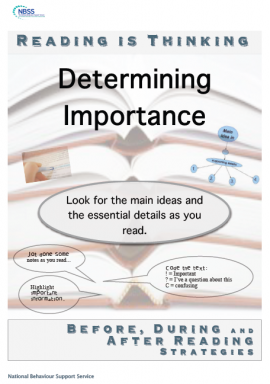
- Determining Importance
- Summarising & Synthesising
- Monitoring & Clarifying Comprehension
The NBSS supports partner schools to implement effective practices to support adolescent literacy:
- The direct and comprehension strategies
- Explicitly teaching vocabulary
- Explicitly teaching writing strategies
- Providing opportunities for extended discussion of text meaning and interpretation
- Increasing student motivation and engagement in literacy learning
- Making available intensive and individualised interventions for struggling readers.
‘To acquire literacy is more than to psychologically and mechanically dominate reading and writing techniques. It is to dominate those techniques in terms of consciousness; to understand what one reads and to write what one understands: it is to communicate graphically. Acquiring literacy does not involve memorising sentences, words or syllables - lifeless objects unconnected to an existential universe - but rather an attitude of creation and re-creation, a self-transformation producing a stance of intervention in one's context.’ (Paulo Freire, 1973)
NBSS Language & Literacy
Interventions in Schools
Research points to the importance of recognising the links between behaviour and academic problems and coordinating systems for prevention and intervention in both areas.
NBSS research has also pointed to the association between failure with reading and behaviour difficulties. For example, an exploration of the reading ages of students (N=2187) receiving NBSS Level 3 behavioural support from the Spring Term 2009 to the Spring Term 2012 revealed that 66.3% (N=1450) of students were reading three or more years below their chronological age. Additionally, 4.3% (N=96) of the students receiving NBSS Level 3 support had reading ages of 7 years or less.
The negative effect of poor reading skills are well documented and wide ranging, for example poor academic achievement, low self-esteem, lower motivation to read, disengagement with learning and school, and behavioural problems.
From NBSS work in post-primary schools it is clear that the strong connections between academic achievement and behaviour can mean that addressing challenges in one area can reduce difficulties arising in another.
Essential Components of Reading
'Reading is a complex process involving a network of cognitive actions that work together to construct meaning.' (Baker & Brown, 1984)
Common themes also emerge from the research literature on the essential components of effective reading instruction for adolescent learners. Among these is the need for:
- All subject teachers to integrate the explicit and direct teaching of vocabulary, comprehension and writing skills necessary for learning in their subject area.
- The need to develop and improve the fluency skills of some students.
- The need for systemic, intensive and explicit teaching related to phonics and phonemic awareness for a small number of students.
As part of its Model of Support the NBSS works with schools in developing and implementing specific interventions, strategies and approaches that support the development of the essential areas of reading - phonics and phonemic awareness, vocabulary, fluency and comprehension - for adolescent learners who struggle with reading.
However , the diversity of student needs, learning style, teaching style and classroom conditions that exist in any school means that no one ‘right’ strategy or programme holds the answer to addressing literacy difficulties. But using evidence-based programmes and approaches as ONE element of targeted support can play an important role in a school’s repertoire of prevention and intervention supports for students.
Among the many interventions, programmes and resources used in NBSS partner schools to support the development of key literacy, language and learning skills are:
- Catch Up Literacy,
- Catch Up Numeracy,
- Comprehension Strategy Instruction (CSI),
- Digital Games,
- Wordshark,
- Numbershark,
- Numeracy Workout,
- Rapid Plus,
- High Interest/Low Readability Books (see NBSS READ resource),
- Toe by Toe,
- SRA Corrective Reading,
- SRA Reading Laboratory,
- AcceleRead AcceleWrite,
- ARROW,
- The Wordsworth Programme,
- Trugs,
- The Vocabulary Enrichment Programme,
- Bridge to Vocabulary,
- NBSS Vocabulary Resources,
- Flip for Comprehension,
- Comprehension Board Games,
- Spotlight on Reading & Listening Comprehension,
- Spell Write Right Programme,
- Storymaker's Chest,
- Story Cubes,
- SNIP Literacy Programme,
- NBSS comprehension strategy, study strategy and learning strategy resources.
As part of the 'Teacher as Researcher' Projects the NBSS also works with teachers on literacy, learning and study skills research projects across Senior and Junior Cycle. Teacher as Researcher Projects can be developed at all three NBSS levels of support and tailored to the needs of each school or student group.
NBSS Supporting Speech, Language
and Communication Needs
in Schools
The NBSS Speech and Language Therapist works collaboratively with school staff in targeted schools to provide appropriate intervention to develop and maximise students’ speech, language and communication skills as well as their learning and socialisation skills. For example, the focus of an intervention could be on:
- developing vocabulary with an individual student or with a small group or whole class;
- supporting reading and understanding of stories,
- developing the skills of telling and writing stories and answering questions;
- developing a young person’s social skills e.g. eye contact, conversation skills.
Find out more about speech, language and communication needs here.
NBSS Literacy and Learning
to Learn Resources
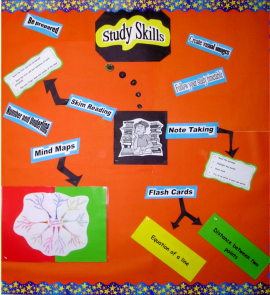
The NBSS teacher and student resources support the development of academic literacy, learning and study skills at Senior and Junior Cycle. On the Publications & Resources section of this site there are over twenty five individual learning, reading comprehension, vocabulary, writing and study strategy resources available to download, as well as vocabulary notebooks, reading and learning bookmarks and posters.
Also check out our 'Links' page